When to send
Step 3 of every send form. Two words about it: now, or later.
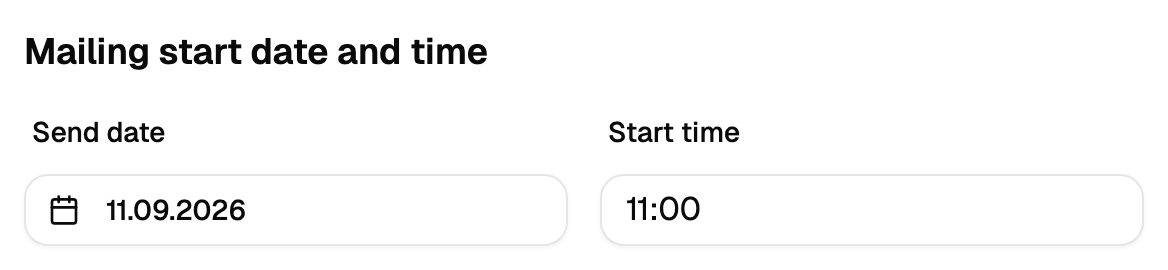
Where the time zone lives
The date and time are read in your account's time zone — the one picked up from your browser when you registered, and not the recipient's. If you work from one country and send to another, this is the thing to check first: the whole difference between a campaign at nine in the morning and one at six is made of it.
The zone is shown in the settings, and your manager moves the account to another one when you ask.
Setting the start time
The start is now, or any moment ahead of now, and the form says so as soon as an earlier time is entered.
The trap is a time that was still ahead while you were filling in the form and slipped into the past by the time you pressed the button. Set the start a few minutes forward.
An even spread
A campaign can go out gradually. Send evenly distributes the messages between the start and the end you set — this is one campaign stretched over an interval, not a campaign repeated several times.
It is used to keep an operator from seeing a burst, and to keep your own support line from receiving every reply within a single minute.
The campaign lifetime
Active until is the moment after which the campaign stops trying. What has not reached its recipient by then stays where it is.
This matters for anything time-bound: a code, an invitation to an event, a reminder about today. A message that arrives the next morning is worse than one that does not arrive.
An even spread and a lifetime are settings of a campaign. For a single message the third step asks for one thing — the start time.